Wednesday, 1 August 2012

The Isle of Cumbrae

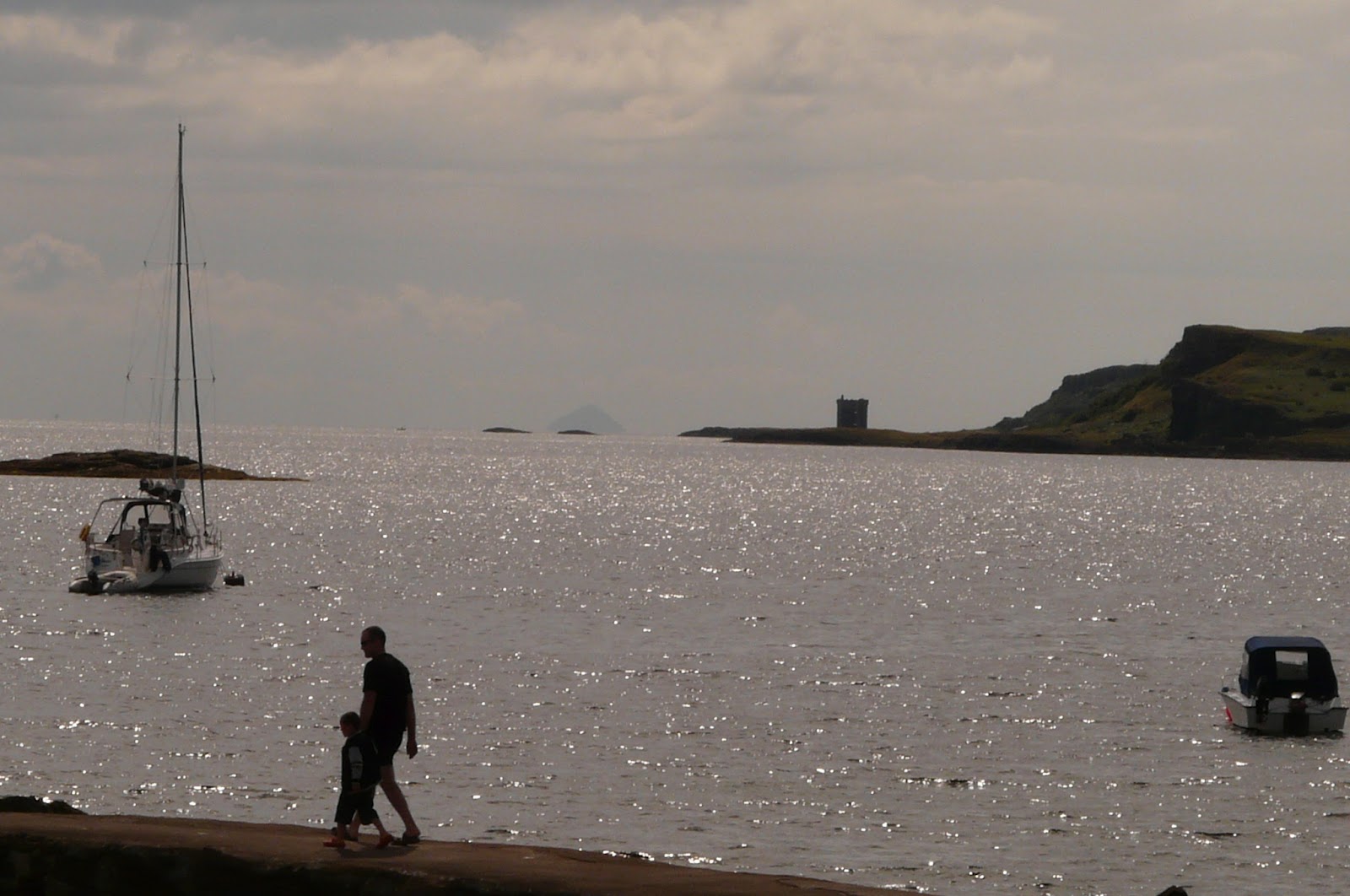
Do not be fooled by the blue skies, the warm sunshine and the palm trees. This is not some Caribbean Island retreat of  millionaires!  No! This is a tiny island about an hour down the coast from Glasgow.
It lies in the Clyde, just across the water from the wee bustling town of Largs, famous for Nardini's Ice Cream!

You have to take a short ferry crossing to reach the island. On the day we went, everyone had decided to go, so there was a wait for the ferry.
Once you are there, life runs at a much slower pace. The first thing you notice are bicycles and tricycles of all shapes and sizes. A great many of the folk who go there go to cycle the 11miles round the Island. It is a kind of tradition. And there are a number of lcations who hire bikes out by the hour, by the day or by the week. As you walk or drive, the bikes are everywhere. They have right of way!
You will not find any speeding motorists on this island, not with so many cyclists of all ages - from 5 to 75!
Not that you would want to drive fast anyway. There is nowhere to race to!

The only town on the island is summer called Millport. It is not very large. There are lots of eating places, some shops selling all sorts of souveniers, and some shops aimed at the local population. And bike hire shops.

The island also lays claim to having the smallest cathedral in Europe. During the summer months, there are Sunday afternoon musical recitals in the Cathedral.

And a regular visitor to the island is " Waverely", the world's last sea going paddlesteamer. She ploughs up and down the Clyde during the summer season, before sailing to the South for August and September, before returning to her winter berth on the Clyde at Glasgow.

There are actaully 2 Cumbraes' - Little Cumbrae and Great  Cumbrae. From the photos you will see that Little Cumbrae boasts a castle that may have been built by Robert The Bruce.
To the left of that on the coast going towards Ayr, at West Kilbride, there are the ruins of Portencross Castle. In times gone past, it was a staging post for the transport of dead Scottish Kings on their way to be buried on the St Columba's holy island of Iona.


http://en.wikipedia.org/wiki/Great_Cumbrae

http://en.wikipedia.org/wiki/West_Kilbride


http://en.wikipedia.org/wiki/PS_Waverley


The beach on Cumbrae

Summer happiness

panoramic view from the Harbour

the harbour at Millport

the promenade

castle on Little Cumbrae

Main Street Millport

bicycles for all ages...

...and of all sizes

Therese and Theresa set off round Cumbrae

Little Cumbrae Castle

Portencross castle at West Kilbride

beach scene


ferry offloading

ferry approaching Largs

Saturday, 28 July 2012

Vindolanda

Vindolanda is a privately owned site close to Hadrian's Wall.
It is the site of a ,castrum a Roman Auxiliary fort. It was there to guard the  Stanegate ,he Roman road which ran from Newcastle to the Solway Firth at the border with Scotland.

The first records of the site go back to the 1580s, and it gives us a view of the site before the large scale destruction of the fort for the building of homes and farms and churches. Like Hadrian's Wall, it became like a quarry.
It is interesting to note that as late as the 1700s, the Bath house was still roofed.

There are 5 timber forts on this site. Each was demolished to make way for the new. Auxiliaries were soldiers who had been recruited locally, although it is clear there were soldiers from Gaul ( France ) here too.
These forts pre dated Hadrian's Wall, and when the Wall was completed, the fort was abandoned and the troops moved to nearby Housesteads Fort, which was on the route of the wall.
It would appear that shortly after this, the Auxiliaries were moved to duties on the Antonine Wall in Scotland.

A vicus, self goverening village grew up beside the fort, and was a source of shops, bars and entertainment for the soldiers.

In 208AD major rebellion against the Romans took place, and the Emperor  Septimus Severus came to Britian to deal with the problem. A large stone fort was then built on the site.
It remained in use until 285AD.

The site is very interesting. There is a live dig going on, excavating part of the fort. There is a replica of  Hadrian's Wall in turf, wood and stone which gives the viewer a better understanding of the dimensions of the real thing, since the exisiting wall has lost most of its height.
The museum on site displays many fascinating artefacts including the Vindolanda Tablets.

A few miles away, a second site, the Roman Army Museum gives a glimpse of the life of a Roman Soldier. There is an interesting 3D Film, The Edge of the Empire, though I think it could have been done much better. It was hard to keep track of where the places shown actaully were in relation to the Wall.


http://en.wikipedia.org/wiki/Vindolanda

http://en.wikipedia.org/wiki/Vindolanda_tablets


the diggers


the Bath House

general view


replica of Hadrian's Wall

replica Temple

Roman walls


panoramic views of the Site


Hadrian's Wall climbing to its highest point

Tuesday, 24 July 2012

Hadrian's Wall Revisited

I have posted previously about this amazing feat of engineering. But one cannot fail to be impressed whenever the Wall is seen.

The Wall is over 70 miles in length. It was made of squared stones, was almost 10 feet wide and height ranged from 16 to 20 feet. It was an impressive piece of work, and to those who wished to challenge it would have been a terrifying thought.
Of course it was not only the wall,but the the ditches that had been constructed in front of it, the dead straight road which ran along behind it, and the forts, both large and small to be found at regular intervals along the Wall.

To stand on the wall and see it stretch into the distance, climbing hills and descending into steep gorges always amazes. No wonder it is world heritage site.

After almost 1800 years it still stands. Not to its original dimensions. After the Romans withdrew, it became a quarry for home builders. And farming destroyed sections of it too. Only around the late 1800's did protection begin to safeguard this historic site.

The Wall marked the edge of the Western edge of the Roman Empire. Scotland was never occupied like other territories and was not considered a part of the Empire.
The wall would keep out those from the North.
There was nevertheless a Roman presence in Scotland. There were forts, bath houses, and the easily identifiable long straight roads.
There was also a Wall. The Antonine Wall. Not made of stone, but of earth. It runs right across Scotland from the Clyde on the west coast to Edinburgh on the East Coast.

 But Scotland was not rich in natural resources that were of interest to the Romans. So there was little point in expending valuable resources on the rugged Scottish land.

The ruins of the Forts which lie along the Wall make it easy to appreciate the power of this Army.
Housesteads and Birdoswald are fascinating places to visit.

The National Trust and English Heritage manage some of these sites, and Vindolanda is a privately owned museum. There are others too.
In summer, the sites are busy and many walkers like to hike along the Wall.
In winter, some of the sites are closed, but it is equally fascinating to visit in winter, and imagine how these foreign soldiers would have felt about cold Britain.
There are links here to a few of the web sites about Hadrian's Wall.

My photos sadly do not do justice to the Wall. You will have to come and see it yourself to really appreciate the scale of this monument to the Power of the Roman Army.

http://www.hadrians-wall.org/
http://en.wikipedia.org/wiki/Hadrian's_Wall
http://www.nationaltrust.org.uk/hadrians-wall/
http://www.vindolanda.com/
http://www.bbc.co.uk/history/ancient/romans/hadrian_gallery.shtml

Wall near Birdoswald Fort

Wall continues east

Wall stretching across fields

Roman Fort at Chesters

Chesters Fort

Bath House at Chesters

model of Chesters fort. Bathouse near river

Housesteads Fort in the distance

exterior wall at Housesteads

The wild landscape of the Wall

Chesters bath House

Rugged Northumberland landscape


Monday, 23 July 2012

Hexham

Today we drove the 15 miles or so to the market town of Hexham.
Hexham has a population of about 12000 folk. The streets are narrow and some of the houses are quite old.
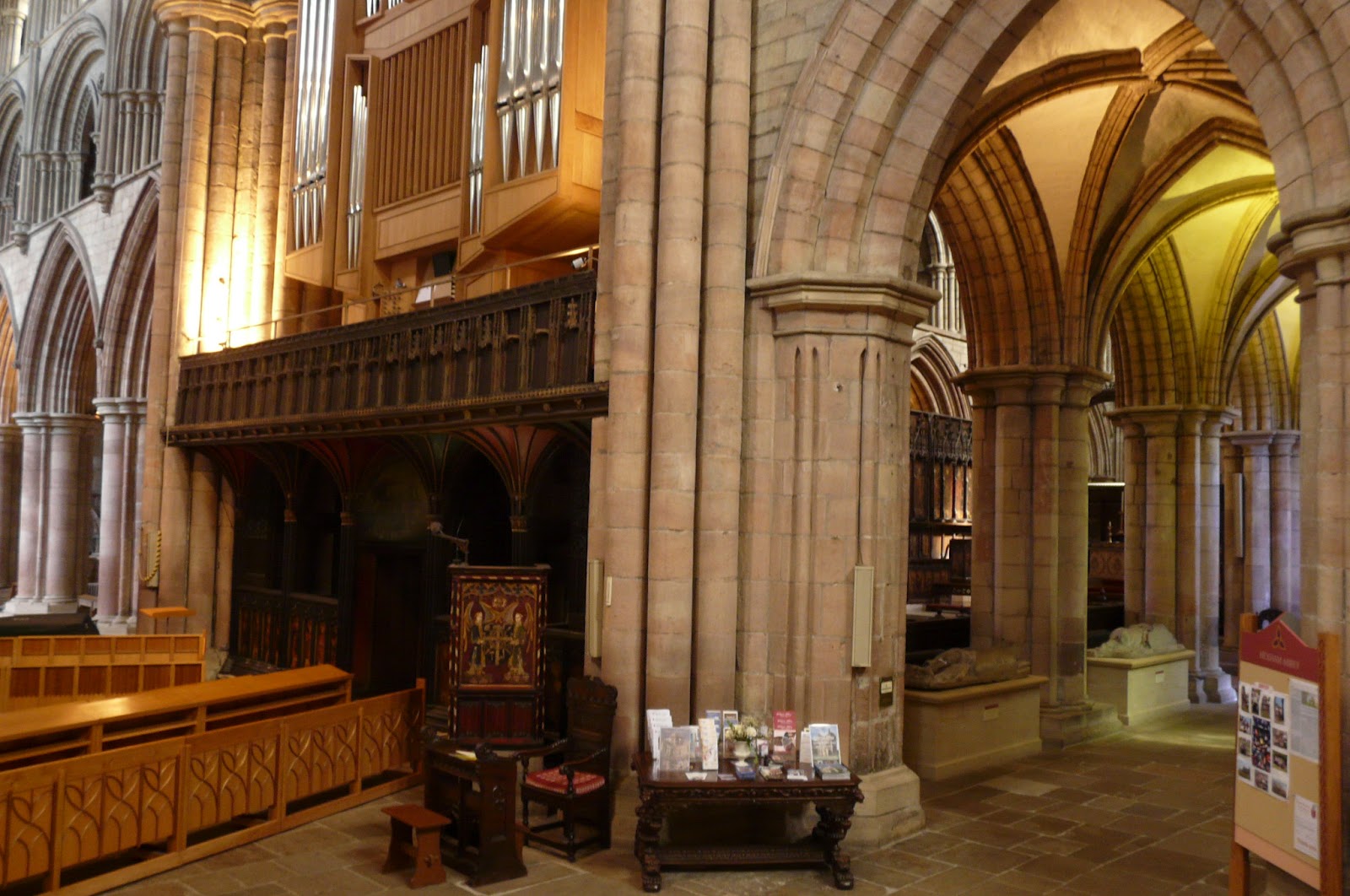
The abbey lies at the centre of the town. It was founded around 674 by St Wilfrid, and part of the present abbey, the underground vault, or crypt, dates back to that era. stones from the nearby Hadrian's Wall were used in the construction of the Abbey. Most of the present building is from the 11th Century.
The Moot Hall, and the Gaol are also ancient buildings.
Being so close to the Scottish border, Hexham was much troubled during the years of conflict between England and Scotland. Such worthies as William Wallace, Robert the Bruce and
King DavidII were unwelcome visitors to the town.

St Wilfrid has a long and interesting history, and there are links to it on this page. I suggest you follow the leads. It is worth reading.
He spent time at Lindisfarne, Canterbury, Gaul and Rome before returning to Northumberland.
St Bede wrote at length about Wilfrid. He appears to have liked his luxuries and travelled with a large retinue. He ruled a large number of monasteries and claimed to have introduced The Rule of St. Benedict to England.

http://en.wikipedia.org/wiki/Hexham

http://en.wikipedia.org/wiki/Wilfrid

Hexham Abbey

side altar

side aisle

the night stairs

looking to the main altar

the main altar

7th Century crypt

7th Century Bishop's chair

organ made in Pennsylvania

the pulpit